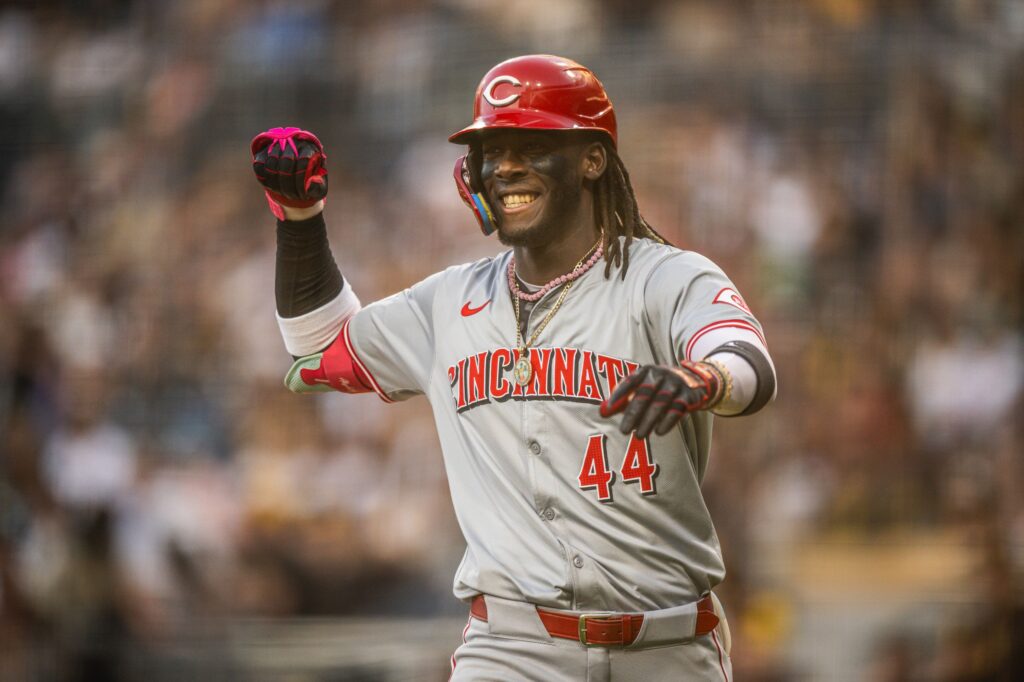
Elly De La Cruz is one of baseball’s most electric players to watch. From making 100+ mph throws from shortstop, running the bases with blazing speed and hitting tape measure home runs, De La Cruz exemplifies the exciting nature of Dominican baseball. While he is a fun and dynamic player, he is not without his downsides—namely, a high number of strikeouts. Watching film of him from his rookie year to this year, it is clear he and the Reds coaching staff have made adjustments in his swing mechanics to yield better results.
During his rookie year, De La Cruz held the bat off his shoulders, close to his batting helmet. As he loaded his weight on his back leg, he had a hitch in his swing which delayed the initiation of his swing. These mechanics often work for rookie phenoms breaking in at the major league level, when pitchers have limited data on them. The hitch in Elly’s swing created a longer bat path, which made it harder to square up pitches outside his wheelhouse. Pitchers began to capitalize on the longer path by pounding the strike zone, knowing that it would take him more time to begin his swing and arrive late to the pitch. While a large part of his high strikeout rate is also plate discipline, the lateness of his swing resulted in a lot of swinging strikeouts on balls in the strike zone as well, as evidenced by the video below.
The side by side image below shows the difference in De La Cruz’s mechanics from his rookie year (left) and this year (right). When he was a rookie, De La Cruz loaded up early before the pitcher reached his release point, emphasized by the high leg kick. He found success with this technique by sitting on the fastball, the pitch he slugged more than any other in his rookie year, and punishing poorly located changeups, which effectively act like batting practice pitches. However, this quick a load limited his ability to wait on quality off speed and breaking pitches, leading to more strikeouts and poor contact. His whiff rates on breaking and off speed pitches in his career thus far have been much higher than his whiff rate on the fastball.
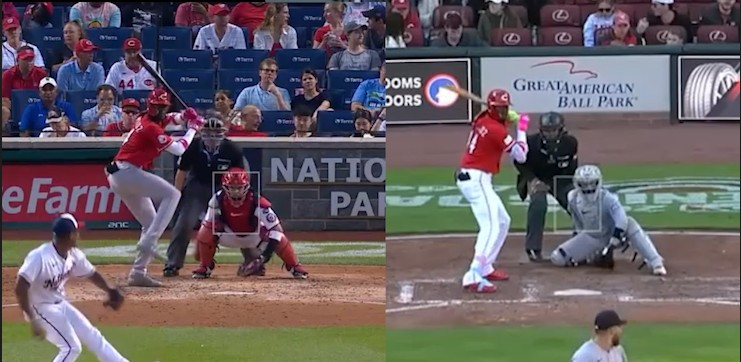
Over the past two seasons, De La Cruz has adjusted his swing mechanics to much better results. The image on the right (2026) displays the same point in the pitcher’s delivery, yet his leg remains planted in the box. A later load and less pronounced leg kick allow him to remain balanced on breaking balls (sliders and curveballs), giving him the ability to drive them over the wall for a home run.
De La Cruz’s hands are now held close to his chest, near the letters of his jersey, allowing for a quicker swing path to the ball. The absence of a hitch and less pronounced mechanics allow him to track the ball better and generate quality contact across all areas of the plate. Since making the shift in 2025, his whiff rates on breaking and off speed pitches have decreased and evened out considerably.
(Note: 2026 Whiff% is based on a sample size of just 10 games)
| Year | Pitch Type | Whiff% |
| 2026 | Fastball | 12.5 |
| 2026 | Breaking | 39.1 |
| 2026 | Off speed | 58.8 |
| 2025 | Fastball | 28.2 |
| 2025 | Breaking | 33.5 |
| 2025 | Off speed | 36.7 |
| 2024 | Fastball | 26.1 |
| 2024 | Breaking | 41.4 |
| 2024 | Off speed | 41.6 |
| 2023 | Fastball | 22.4 |
| 2023 | Breaking | 36 |
| 2023 | Off speed | 34.4 |
De La Cruz has also shortened his bat path to the ball allowing him to catch up to more fastballs. This side by side video shows similar pitches and the adjustments he has made. The video on the left is him striking out against Jordan Montgomery on a high fastball in 2024. The old hitch delayed swing initiation, causing him to be late on a pitch that he sees the best. The video on the right is from a game on March 31 against Hunter Barco. Keeping his hands close to his body makes De La Cruz’s bat path quicker and smoother than before. This adjustment allows him to catch up to the high fastball and hit it to the opposite field for a home run. The tweaks in his mechanics allow him to stay balanced at the plate while reducing time spent in his load.
De La Cruz’s power potential and swing mechanics as a rookie were reminiscent of Bryce Harper’s early in his career. Both hitters generated enormous torque and momentum in their swings, which often led them to try to pull every ball. Pitchers recognized this tendency in both hitters and attacked the outer part of the zone, resulting in whiffs or weak contact.
Over time, Harper simplified his swing, tightening his hand path and quickening his load, which improved contact without sacrificing power. It appears De La Cruz has made similar adjustments and is looking to elevate his game even further this season.
The similarities in their mechanics and the mechanical changes they have both made can be seen below.

0 Comments