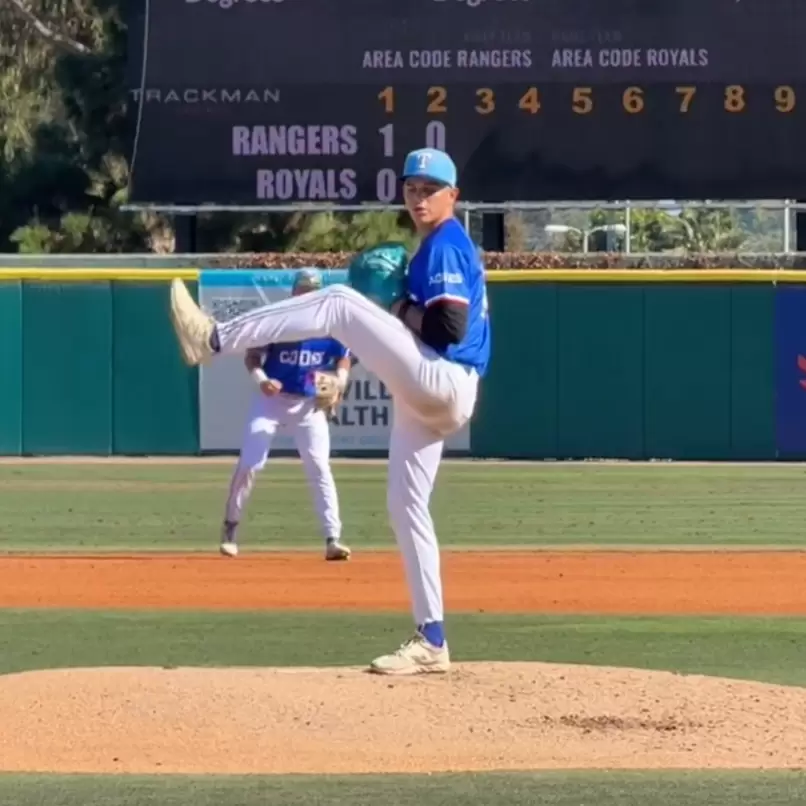
| Player Information | Player Details | Additional Information |
| Prospect Name | Trey Rangel | Position: Right-Handed Pitcher |
| School/Class | University of Texas | Freshman |
| Date of Birth (Age) | April 12, 2007 | Age to Class Model: Old for his class |
| Physical Specs | Ht: 6’ | Wt: 180 lbs | Lean, athletic frame with potential to add strength as he matures |
| Draft Outlook | TBD (Pending Collegiate Development) | Ceiling: Mid-rotation starter |
20-80 SCALE TOOL GRADES
| Tool Component | Current Grade | Future Grade | Scouting Notes |
| Fastball | 50 | 55 | 95–97 mph with arm-side run, sequences it with his secondaries to keep hitters off balance |
| Slider | 50 | 55 | Most effective secondary offering, good vertical movement, but inconsistent command |
| Changeup | 40 | 50 | Good vertical movement, struggles to locate the pitch effectively |
| Curveball | 50 | 55 | Similar initial action to the slider, but with a different breaking pattern; works well when sequenced with slider |
| Command | 45 | 50 | Inconsistent command, with multiple moving parts in his delivery potentially contributing to his difficulties locating pitches |
| Overall Future Value | 45 | 50 | Ceiling: Mid-rotation starter if his command and delivery consistency improve. Likely outcome: Back-end starter, with middle-relief potential if his command doesn’t develop sufficiently |
Mechanics
Trey Rangel features a deceptive delivery with a three-quarter arm slot and a slingshot-style release that can make it difficult for hitters to pick up the baseball. His mechanics are similar to those of Sonny Gray and his release point is akin to that of Domingo Germán. There are multiple moving parts in his upper body. He maintains a consistent arm slot across his repertoire, helping disguise his pitches.
Fastball
The fastball is the main pitch in his arsenal, sitting around 95–97 mph with arm-side run. He is able to elevate the pitch and sequence it with his secondaries to keep hitters off balance. The pitch’s effectiveness hinges on his ability to properly locate it, as hitters have been able to make contact when it is thrown in the middle third of the plate.
Slider
His slider appears to be his most effective secondary offering due to its breaking action and ability to induce swings and misses. The pitch features good vertical movement, though he struggles to command it consistently. He hit a batter with the slider during a showcase game, highlighting his occasional difficulties with location. Rangel has shown the ability to backdoor the pitch against left-handed hitters, particularly when sequencing it with his curveball. His ability to mix his secondary offerings and change speeds adds another dimension to his repertoire.
Curveball
His curveball has a similar initial action to the slider but features a different breaking pattern, which creates additional deception when the two pitches are sequenced together. He struggles to command the pitch on occasion. The pitch does not have as much break as Clayton Kershaw’s 12-6 curveball, so location is key to its effectiveness. When properly located, it can induce weak contact and generate ground balls. Its late breaking action induces swings and misses consistently.
Changeup
The changeup sits in the high 80s. Correctly locating and commanding the pitch are key for its effectiveness. The pitch does not have a huge velocity differential compared to the fastball. The pitch itself is not tremendous, but the vertical movement paired with the fastball makes it effective when he wants to challenge hitters. The pitch does not induce a lot of swings and misses, underscoring the need for him to harness his command of the pitch.
Command
Rangel briefly takes his eyes off the plate during his delivery, looking toward the on-deck circle before refocusing on the plate as he releases the pitch. I believe this, combined with the multiple moving parts in his upper body, may be contributing to his inconsistent pitch location.
While he can locate his fastball despite this, he struggles with command of his changeup and breaking pitches. Although he occasionally demonstrates the ability to locate his secondary offerings, his overall command remains inconsistent. Rangel has raw talent, and his time at the University of Texas will provide him with an opportunity to refine his mechanics and improve his command.
Projection
Rangel possesses the repertoire and present velocity to develop into a major league starting pitcher, though improvements in command and delivery consistency will be critical to reaching that ceiling. Pitching in the SEC at Texas will aid in his continued development as he will be facing a higher level of competition. SEC hitters will expose holes in his game, giving him opportunities to improve over his collegiate career and give him the best chance for success at the professional level.
At the present time, his ceiling looks to be a middle-of-the-rotation starter. Improving his mechanics and developing a more repeatable delivery could improve his command and help him pitch deeper into games. His more likely outcome is a back-end starter. If his command does not develop sufficiently, his fastball and secondary offerings could forge a path to a bullpen role at the big league level.


0 Comments